

Three regulatory developments across the UAE, Nigeria and Kenya recently caught our attention.
On the surface, they addressed different parts of the financial system. Dubai advanced its framework for virtual assets. Nigeria introduced a new model for coordinating oversight of the same market. Kenya tightened supervision of digital lenders.
Viewed individually, each is an important regulatory development. Viewed together, they point to something much bigger.
For decades, financial regulation largely followed the same sequence. Innovation emerged, markets developed, regulators assessed the risks, new rules were introduced and firms adapted. That approach worked when innovation evolved over years rather than months.
Digital finance no longer moves at that pace.
Products launch faster. Business models evolve continuously. Risks emerge in real time. Regulators are therefore changing more than their rulebooks. They are redesigning how they supervise markets, allocating responsibilities more clearly, improving coordination across agencies and strengthening oversight as markets mature.
That is the thread connecting these three developments.
- The UAE is refining regulatory jurisdiction.
- Nigeria is improving regulatory coordination.
- Kenya is strengthening conduct supervision.
Different markets. Different priorities. But each reflects the same reality: regulation is becoming a continuously evolving operating model rather than a static framework that changes only when legislation is updated.
For firms operating across these markets, that shift matters. Regulatory strategy is becoming an ongoing capability rather than a milestone achieved when a licence is granted.

UAE: jurisdiction is becoming as important as licensing
Revolut’s recent in-principle approval from Dubai’s Virtual Assets Regulatory Authority (VARA) attracted considerable attention. Coming on top of the payment permissions it already holds from the Central Bank of the UAE, it marks another step towards building a broader digital financial ecosystem in the country. [1, 2]
The approval itself is significant. What interested us more, however, was what it says about the direction of regulation in the UAE.
Rather than creating a single framework for virtual assets, the UAE has deliberately developed a layered regulatory model where responsibility depends on both geography and activity. VARA regulates virtual assets within Dubai, excluding DIFC, under authority delegated at the federal level through Cabinet Resolution No. 112 of 2022. ADGM and DIFC continue to operate under separate regulatory regimes through the FSRA and DFSA respectively, while AED‑referenced payment tokens fall within the remit of the UAE Central Bank and investment‑type virtual assets remain subject to the federal capital markets regulator, alongside local supervision by VARA, DFSA and FSRA.
For firms entering the UAE, the first question is no longer simply how to obtain a licence.
It is understanding which regulator has jurisdiction over which activities, how those responsibilities interact and how they may change as a business expands across products, customers or jurisdictions.
That distinction is becoming increasingly important.
Capital, governance and risk management expectations have continued to evolve across VARA, the CMA, DFSA and FSRA during 2026. Firms operating across more than one framework should expect regulatory expectations to continue developing rather than assuming certainty begins once a licence has been granted. [4]
The practical implication is straightforward. Licensing provides market access. Long-term success depends on understanding the regulatory architecture well enough to adapt as that architecture continues to evolve.
The UAE’s approach also demonstrates a broader point. As digital finance becomes more sophisticated, regulators are recognising that effective supervision is no longer achieved through a single authority. It requires clearly defined responsibilities, coordination between regulators and the flexibility to respond as markets develop. The focus is shifting from simply regulating products to regulating increasingly complex financial ecosystems.
Nigeria: coordination is becoming a regulatory capability
Nigeria’s Presidential Executive Order on Virtual Assets Coordination is significant for reasons that extend well beyond digital assets.
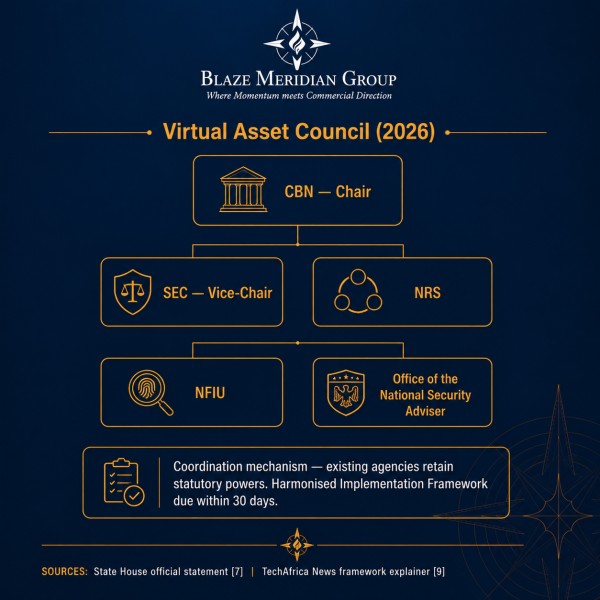
The Order establishes a Virtual Asset Council chaired by the Central Bank of Nigeria, with the Nigeria Revenue Service and the Securities and Exchange Commission as vice-chairs, alongside the Financial Intelligence Unit and the Office of the National Security Adviser. Rather than creating another regulator, it establishes a formal structure for coordination while leaving each authority’s statutory powers intact. [7, 9]
That distinction matters.
As digital asset markets have expanded, responsibility has increasingly been shared across central banks, securities regulators, tax authorities, financial intelligence units and law enforcement agencies. Without clear coordination, overlapping mandates can slow decision-making, create uncertainty for firms and weaken supervision.
Nigeria’s approach acknowledges that challenge directly.
The new Council is intended to remove much of that friction. The SEC continues to oversee securities-type virtual assets, while the Central Bank focuses on payments, settlement and custody. A 30-day timetable for a Harmonised Implementation Framework demonstrates the emphasis on operational coordination rather than simply announcing another policy initiative. [7, 9]
This is happening alongside broader regulatory reforms. The SEC has strengthened capital requirements for digital asset firms, legislation continues to progress and more platforms are moving within the formal regulatory perimeter. [8]
Taken together, these developments suggest Nigeria is entering a different phase of market development. The priority is no longer simply defining regulatory responsibilities. It is ensuring regulators can work together effectively as markets become larger, faster and more interconnected.
For firms, this reduces more than regulatory uncertainty. Better coordination should also lead to more consistent supervision, clearer accountability and faster regulatory responses when markets evolve or risks emerge.
The broader lesson extends beyond Nigeria. Financial innovation increasingly cuts across payments, capital markets, taxation, financial crime and consumer protection. Regulators organised around traditional institutional boundaries will inevitably face challenges keeping pace. Coordination is therefore becoming a regulatory capability in its own right rather than an administrative exercise.
Kenya: supervision does not end with licensing
Kenya illustrates a different stage in the evolution of digital finance regulation.
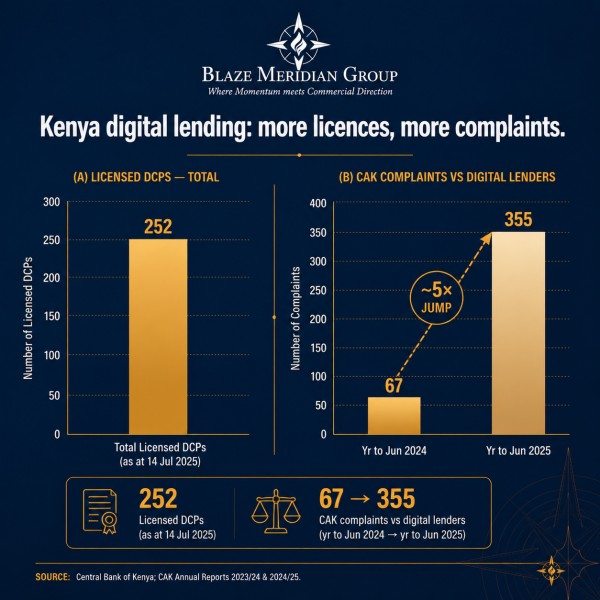
The Central Bank of Kenya recently licensed a further 25 Digital Credit Providers, bringing the total number of licensed firms to 252. Within only a few years, digital lenders have moved from operating largely outside the regulatory perimeter to becoming one of the country’s most actively supervised financial sectors. [13]
That is a considerable regulatory achievement.
It also highlights an important reality.
Licensing firms is only the beginning of effective supervision.
The Competition Authority of Kenya’s latest published annual report shows complaints against digital lenders increasing from 67 to 355 in a single year. The majority relate to misleading representations, undisclosed charges and unilateral changes to loan terms. [12]
Those figures help explain why the regulatory conversation in Kenya is changing.
The focus is moving beyond who should be licensed towards how firms behave once they enter the market.
The Treasury has proposed tiered oversight that recognises differences in size and risk across lenders while increasing penalties for abusive collection practices. At the same time, the Central Bank has consulted on stronger disclosure standards, governance requirements and fitness criteria. Alongside this, seven financial regulators are working towards a common Financial Consumer Protection Framework intended to harmonise conduct standards across the financial sector. [15, 16]
This represents a natural progression in regulatory maturity.
When a new market develops, regulators understandably focus on bringing firms within the perimeter. Once that objective has largely been achieved, attention shifts towards customer outcomes, governance, transparency and market conduct.
Kenya is now entering that second phase.
Its experience is relevant well beyond digital lending. Many fast-growing areas of financial innovation are likely to follow the same path, moving from questions of market access towards questions of market behaviour as sectors mature.
Looking beyond the headlines
Taken individually, these developments address different markets, different regulatory structures and different parts of the financial system.
Taken together, they tell a broader story about the direction of financial regulation.
For much of the past two decades, the focus of regulatory reform was on developing the right rules. Today, the challenge is different. Regulators are increasingly focused on developing the right operating model to supervise markets that evolve continuously.
The three examples illustrate that progression from different angles.
In the UAE, the emphasis is on allocating jurisdiction clearly across multiple regulators while allowing specialist frameworks to develop alongside one another.
In Nigeria, the priority is improving coordination so that different agencies can respond more effectively to increasingly interconnected markets.
In Kenya, the focus has moved beyond licensing towards supervision of conduct, recognising that protecting market integrity requires more than bringing firms inside the regulatory perimeter.
Different markets are naturally moving at different speeds and responding to different priorities. There is no single blueprint for regulating digital finance, nor should there be.
What is striking, however, is that they are all investing in regulatory capability as much as regulatory policy.
That distinction matters.
For firms expanding into new markets, regulatory strategy can no longer be viewed as a licensing exercise completed before launch. It needs to become part of how the business is designed, governed and managed over time.
The strongest businesses will not necessarily be those that navigate today’s rules most effectively. They will be those that build governance, risk management and operating models capable of adapting as regulatory expectations continue to evolve.
That requires a different mindset.
Regulation is no longer simply an external framework that businesses respond to. Increasingly, it is becoming an integral part of competitive strategy, influencing decisions on market entry, product design, governance, partnerships and long-term investment.
This is particularly relevant for financial institutions, fintechs and technology providers expanding across multiple jurisdictions. The complexity no longer lies only in understanding individual rulebooks. It lies in understanding how different regulatory frameworks interact, where responsibilities overlap and how expectations are likely to develop over time.
That is why these three developments stood out to us.
Individually, each is an important regulatory announcement.
Collectively, they signal something more significant: regulators are adapting their own operating models to match the pace of innovation. For firms operating in digital finance, recognising that shift early may prove just as valuable as understanding any individual regulatory change.
Sources:
[1] Revolut — Revolut receives in-principle approval to provide crypto services in UAE — https://www.revolut.com/news/revolut_receives_in_principle_approval_to_provide_crypto_services_in_uae/
[2] VARA — Public Register (licensed & in-principle firms) — https://www.vara.ae/en/licenses-and-register/public-register/
[3] Government of Dubai — Law No. (4) of 2022 Regulating Virtual Assets — https://dlp.dubai.gov.ae/Legislation%20Reference/2022/Law%20No.%20(4)%20of%202022%20Regulating%20Virtual%20Assets.html
[4] Clyde & Co — The UAE Capital Markets Authority replaces the federal VASP framework (CMA Decision No. 4/R.M/2026) — https://www.clydeco.com/en/insights/2026/april/the-uae-capital-markets-authority-replaces-the-fed
[5] The Official Platform of the UAE Government — Regulation of digital properties — https://u.ae/en/about-the-uae/digital-uae/regulatory-framework/regulation-of-digital-properties
[6] ADGM FSRA — Fiat-Referenced Token regulatory framework — https://www.adgm.com/media/announcements/adgm-fsra-finalises-regulatory-framework-for-regulated-activities-involving-fiat-referenced-tokens
[7] State House, Abuja — President Tinubu signs Executive Order on Virtual Assets, establishes Council — https://statehouse.gov.ng/president-tinubu-signs-executive-order-on-virtual-assets-establishes-council-to-harmonise-regulation-of-digital-economy/
[8] Nairametrics — SEC raises capital requirements for brokers, fund managers, digital firms (₦2bn) — https://nairametrics.com/2026/01/16/sec-raises-capital-requirements-for-brokers-fund-managers-digital-firms/
[9] TechAfrica News — Nigeria Launches Coordinated Regulatory Framework for Virtual Assets — https://techafricanews.com/2026/07/20/nigeria-launches-coordinated-regulatory-framework-for-virtual-assets/
[10] Central Bank of Kenya — Public Notice: Commencement of the Virtual Asset Service Providers Act, 2025 — https://www.centralbank.go.ke/uploads/press_releases/665231223_Public%20Notice%20on%20the%20Virtual%20Assets%20Service%20Providers%20Act%202025.pdf
[11] Kenya Law — Virtual Asset Service Providers Act, 2025 (Act No. 20 of 2025) — https://new.kenyalaw.org/akn/ke/act/2025/20/eng@2025-11-04
[12] Business Daily — Complaints about digital lenders jump five times (CAK: 355 vs 67) — https://www.businessdailyafrica.com/bd/economy/complaints-about-digital-lenders-jump-five-times–5528224
[13] TechAfrica News — Kenya Approves 25 New Digital Lenders as Licensed DCPs Reach 252 — https://techafricanews.com/2026/07/15/kenya-approves-25-new-digital-lenders-as-licensed-dcps-reach-252/
Additional sources for claims new to this version (14–16)
[14] UAE CMA (SCA) — SCA and VARA set regulatory framework for the UAE’s virtual assets sector (delegation under Cabinet Resolution No. 112/2022) — https://www.uaecma.gov.ae/en/media-center/news/9/9/2024/sca-and-vara-set-regulatory-framework-for-the-uaes-virtual-assets-sector-in-boost-to-the-countrys-.aspx
[15] Central Bank of Kenya — The Financial Consumer Protection Framework for Kenya (seven-regulator draft, March 2026) — https://www.centralbank.go.ke/wp-content/uploads/2026/04/Consumer-Protection-Framework-March-2026.pdf
[16] Capital Business / The Kenyan Wallstreet — Treasury proposes tougher rules and higher penalties for digital lenders; CBK drafts tiered oversight — https://www.capitalfm.co.ke/business/2026/03/treasury-proposes-tougher-rules-for-digital-lenders/
One Response