

Jaywan’s issuing network is steadily taking shape. Mbank launched Jaywan debit cards through its Mbank Wallet platform in late 2024, while Emirates NBD and Bank of Baroda were among the institutions included in the scheme’s early rollout. More recently, FAB introduced a domestic-use debit card and CBD launched a prepaid offering for retail customers under a corporate arrangement. A further group of institutions, including ADCB, Sharjah Islamic Bank, Emirates Islamic, Citi, Al Ansari Exchange and Botim Money, have announced their readiness to issue Jaywan cards, extending the scheme’s reach across banks, exchange houses and digital financial-services providers.
By the standards of domestic card schemes, this is a well-sequenced launch. Aligning a national switch, a dozen issuers and four international co-badge partners within roughly the same window is a genuine coordination achievement. But launch coordination and customer adoption sit on different timelines and depend on different levers. History offers a reasonably clear guide to what separates a domestic scheme that becomes people’s default payment instrument from one that remains a secondary card in the wallet, and it is worth examining that history before drawing conclusions about Jaywan’s trajectory.
Around 90 domestic card schemes operate globally today. A useful starting point is to look at the ones that reached genuine majority usage in their home markets and ask what they had in common.
Where mandates have proven decisive
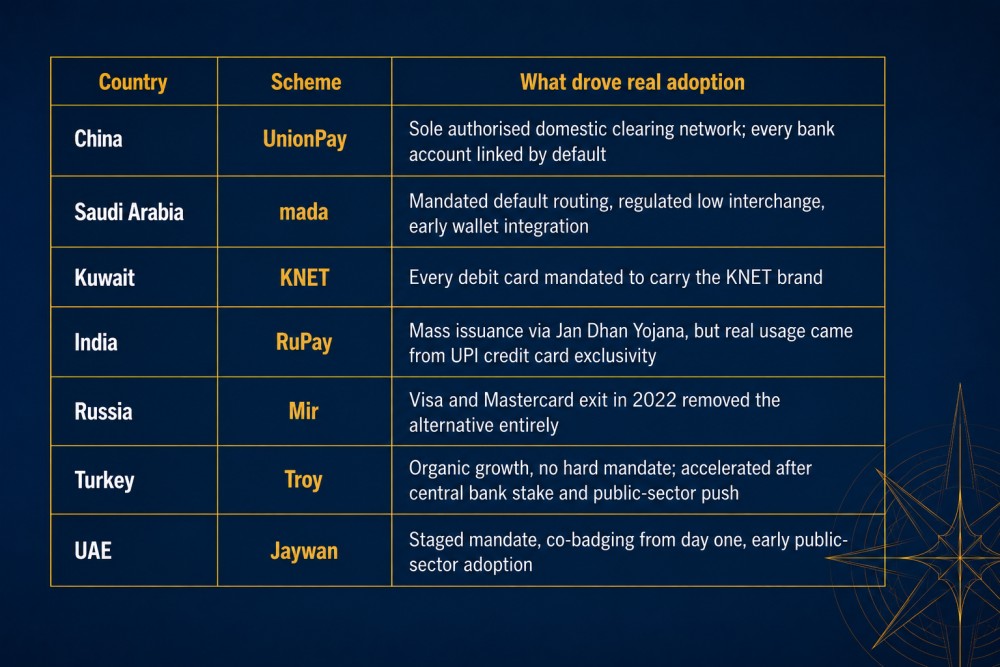
Saudi Arabia’s mada is the cleanest comparison in the region, and the numbers are stark: mada now accounts for roughly 90 percent of cards issued in the Kingdom and over 95 percent of domestic transactions[2] according to SAMA data. That did not happen through customer preference. SAMA requires domestic transactions to route over mada by default, interchange is regulated well below international levels, and every Saudi bank issues mada-branded cards as standard. Choice was never really the mechanism.
The two strongest cases globally, China’s UnionPay and Kuwait’s KNET, make the same point even more starkly. UnionPay became the sole authorised domestic interbank clearing network in China from the outset, with every bank account linked to it by default, and reached near-total dominance within two to three years.[3] KNET has required every Kuwaiti bank to brand its debit cards with the local scheme since 1992[4], giving it a structural monopoly on debit before competition entered the picture. In both cases, adoption was not really a customer decision.
Sustaining and enforcing the mandate matters as much as launching it
UAE Banks Federation chairman Abdulaziz Al Ghurair said in 2024 that banks had agreed to complete migration to Jaywan issuance over two and a half years, after which other card types would stop being issued. AEP’s leadership has indicated that CBUAE will mandate Jaywan debit issuance across all banks over the coming years, though a single authoritative document with a precise regulatory deadline has not yet been published. This is worth monitoring closely, since the experience of mada, UnionPay and KNET suggests that a firm, enforced date is what converts a scheme from voluntary rollout, which tends to plateau, into structural default.
Issuance and adoption are not the same measure
India’s RuPay reached extraordinary card counts quickly, largely through the Jan Dhan Yojana financial inclusion programme, which issued RuPay cards by default to newly banked citizens. At one point over a quarter of those cards carried a zero balance[6], and RuPay’s share of actual transaction value trailed its share of card counts by a wide margin for years, as private banks, facing thinner interchange economics, continued to steer premium customers toward Visa and Mastercard cards sitting in the same wallet.
RuPay’s more meaningful transaction growth came later, and from a different mechanism: regulatory exclusivity on UPI credit card processing, rather than issuance volume. NPCI’s chief executive noted that RuPay’s share of credit card spend reached approximately 16 percent, with growth driven significantly by UPI credit card exclusivity.[7]
The implication for Jaywan is worth stating precisely. Issuance targets and bank mandates will place cards in wallets, but they will not, on their own, move transactions. If a Jaywan debit card sits behind an existing Visa or Mastercard product for everyday spending, the scheme would be tracking RuPay’s early trajectory rather than mada’s. The more informative measure going forward is transaction share, not cards in circulation, and there is a reasonable case for AEP to report the former as the scheme matures.
Co-badging addresses a problem specific to this market
Russia’s Mir illustrates what happens when a domestic scheme has to establish international acceptance entirely on its own terms. Mir’s domestic penetration reached majority share after Visa and Mastercard withdrew from the market altogether in 2022.[8] Its acceptance abroad has remained confined to a small set of aligned countries. A domestic scheme’s growth trajectory looks materially different when the international alternative disappears than when it has to earn share against it.
This distinction matters for the UAE given the composition of its cardholder base. Roughly nine in ten UAE residents are expatriates with significant travel and remittance activity well beyond the GCC, and a domestic-only card would carry limited appeal for that population regardless of pricing. AEP’s co-badging agreements with Mastercard, Visa, UnionPay and Discover address this directly: domestic transactions clear over UAESWITCH at domestic cost, while international transactions route through the partner network. This is arguably Jaywan’s most consequential design choice, and having it largely in place at launch places the scheme ahead of where most domestic schemes stand at a comparable stage.
An early, and useful, public sector signal
Troy’s growth in Turkey accelerated once public institutions were encouraged to use the domestic scheme, supplementing organic bank-led rollout.
The UAE has made a comparable move earlier in the scheme’s life than Turkey did. In August 2026, the Ministry of Finance became the first federal entity to accept Aani and Jaywan for federal service fees and fines, under a new Cabinet resolution, and positioned the move explicitly as a template for other federal entities and collection banks.[12] The transaction volume involved is modest, but the signal is meaningful: it is a proof point that gives other government bodies a basis to follow, and it is a lever the UAE can pull directly rather than one dependent on bank or consumer behaviour.
Also Read: Three markets. One shift in regulatory thinking.
Wallet integration and reward parity determine whether people switch
Turkey’s Troy grew steadily rather than quickly, without a hard mandate behind it, and a decade on it still accounts for roughly 12 percent of card count and 18 to 20 percent of transaction volume.[9] Its growth only picked up once the central bank took a controlling stake and public-sector nudges were introduced. It is a useful reference point for the lower bound: absent a mandate or a compelling reason to switch, adoption tends to climb gradually.
mada’s early integration with Apple Pay and Google Pay, ahead of many comparable schemes, removed one of the more common points of friction in domestic scheme adoption. Jaywan currently has Google Pay and Samsung Wallet live, with Apple Pay rolling out bank by bank.[11] Given how mobile-first UAE consumers already are, completing that integration promptly matters more here than in most markets.
Reward parity is the other half of the equation. Lower merchant costs, cited by Al Ghurair at roughly AED 600 million to AED 1 billion in annual savings across the market,[5] strengthen the case on the merchant side. Consumers, however, rarely switch their primary card for merchant-side economics; they switch for rewards, lounge access and travel benefits, which is the value proposition the new Jaywan-Mastercard co-badged credit card is designed to offer. Whether banks extend genuine value to affluent, mobile customers, rather than treating Jaywan primarily as a compliance requirement, will likely determine whether it becomes a primary card or remains secondary.
Where the UAE’s position differs
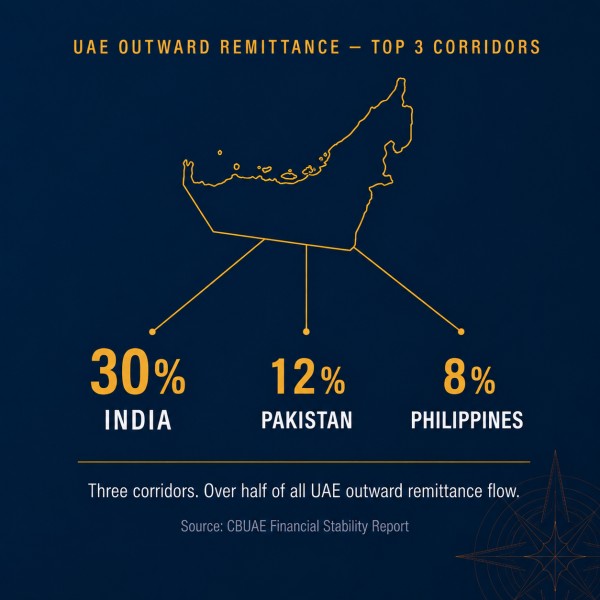
Of the levers visible across mada, UnionPay, KNET, RuPay, Mir and Troy, three carry directly into the UAE’s circumstances: a mandate that is enforced with a clear date rather than aspirational, wallet parity delivered promptly rather than progressively, and co-badging that genuinely resolves the international usability question for a highly mobile population. A fourth consideration is specific to the UAE and worth pursuing deliberately. The UAE is one of the world’s largest sources of outbound remittances, and three corridors, India, Pakistan and the Philippines, account for over half of that flow (roughly 30 percent, 12 percent and 8 percent respectively, according to CBUAE’s Financial Stability Report).[10] The RuPay-Jaywan and UPI-Aani interlinking gives the scheme a genuine, differentiated advantage in the largest of those corridors that no international scheme can natively replicate, and the same kind of interlinking work with Pakistan and the Philippines would be a natural extension rather than treating the India corridor as the complete picture.
The infrastructure and partnerships in place are unusually advanced for a scheme at this stage. What will determine the outcome from here is less visible than the launch itself: whether the mandate carries a firm date, whether wallet integration reaches completion quickly, and whether the value on offer through a Jaywan card gives customers a genuine reason to use it ahead of the card they already carry.
Sources:
| # | Claim | Source / Publication | URL |
| 1 | ~90 domestic card schemes globally | Edgar Dunn / The Paypers — ‘The Rise of Domestic Card Schemes’ | https://www.edgardunn.com/articles/the-rise-of-domestic-card-schemes-taking-back-control-of-payments |
| 2 | mada: ~90% cards issued, ~95% domestic transactions | WhiteSight — ‘How Saudi Arabia Engineered a Digital Payments Boom’; Arab News citing SAMA data | https://whitesight.net/how-saudi-arabia-engineered-a-digital-payments-boom/ |
| 3 | UnionPay: founded 26 March 2002; sole domestic interbank clearing; ~96% domestic share | Wikipedia — UnionPay; Finextra — ‘China’s growth cements UnionPay as world’s largest card scheme’ | https://en.wikipedia.org/wiki/UnionPay |
| 4 | KNET: established 1992; all debit cards mandated to carry local brand; ~80–85% of card transactions | KNET official history — knet.com.kw; Adyen KNET payment method page | https://www.knet.com.kw/about/history/ |
| 5 | UAE Banks Federation: Jaywan to save AED 600m–AED 1bn annually — Abdulaziz Al Ghurair, 14 May 2024 | ANI News / Siasat — ‘UAE: Jaywan poised to generate savings of up to AED 1 billion’ | https://aninews.in/news/world/middle-east/uae-jaywan-poised-to-generate-savings-of-up-to-aed1-billion20240515071137/ |
| 6 | RuPay: Jan Dhan Yojana zero-balance accounts — 76% at launch (Sept 2014), falling to 24% by Aug 2016 | Scroll.in — ‘Is Jan Dhan Yojana really as successful as the government claims?’ | https://scroll.in/article/849604/government-claims-jan-dhan-yojana-was-a-big-success-heres-a-reality-check |
| 7 | RuPay: 16% of total card spend; growth driven by UPI credit card exclusivity — NPCI chief Dilip Asbe, Mumbai Tech Week 2025 | Business Standard — ‘16% of card spends happen on RuPay, half of it on credit via UPI: NPCI’ | https://www.business-standard.com/finance/news/16-of-card-spends-happen-on-rupay-half-of-it-on-credit-via-upi-npci-125022800788_1.html |
| 8 | Mir: domestic penetration post-Visa/Mastercard exit 2022; Visa+Mastercard share fell below 17% | Interfax / Bitcoin News — ‘Share of Visa, Mastercard on Russian market less than 17%’ | https://interfax.com/newsroom/top-stories/117741/ |
| 9 | Troy: founded 2015; CBRT took majority stake 2020; 20% transaction share as of 2025 | Daily Sabah — ‘Türkiye’s Troy card system hits 67 million cards, 20% market share’ | https://www.dailysabah.com/business/economy/turkiyes-troy-card-system-hits-67-million-cards-20-market-share |
| 10 | UAE remittance corridors: India 30.5%, Pakistan 12.2%, Philippines 8.4% | CBUAE Financial Stability Report (2022 data); Zawya / Khaleej Times | https://www.zawya.com/en/economy/gcc/india-pakistan-and-the-philippines-claim-half-of-uae-remittances-booda9he |
| 11 | Jaywan: Google Pay and Samsung Wallet live; Apple Pay rolling out bank-by-bank since iOS 18.4 March 2025 | Khaleej Times — ‘UAE Jaywan card benefits 2026’ | https://www.khaleejtimes.com/business/finance/uae-jaywan-card-benefits-banks-travel-perks-how-to-apply |
| 12 | Ministry of Finance: first federal entity to accept Aani and Jaywan for fees/fines — Cabinet Resolution, August 2026 | Fintech News UAE — ‘UAE Ministry of Finance adopts Aani and Jaywan for federal payments’ | https://fintechnews.ae/32717/payments/uae-ministry-finance-aani-jaywan-payment/ |