

I have spent most of my career selling complex solutions to large institutions, and then leading teams doing the same.
I have worked across Asia, Europe, the Middle East and Africa. Buying approaches need to reflect the market, the institution and the people involved. The pace of decision making, hierarchy, governance, relationships and route into an organisation can differ.
The foundations are remarkably consistent.
These are some of the lessons I have taken from the mandates I have won, the ones I have lost and the teams I have led.
By the time you meet the client, the sales process may already be underway.
Buyers arrive increasingly informed. They have researched providers, spoken to peers and formed views before the first conversation. AI makes access to information even easier, which makes judgement more valuable.
Repeating what is already available adds relatively little. The useful conversation is around what it means for this client. What have you seen elsewhere? What are the implications in their market? Where are the risks? What might they not yet be considering?
I learnt this clearly from being on the other side of the table. As a corporate client, I met around 20 banks. The meetings I found most useful were those where somebody had thought about my business before arriving rather than expecting me to explain it to them.
That experience shaped how I approached sales afterwards.
Understanding what the client might buy is only part of the job. You need to understand how they will buy it.
Complex institutional decisions involve multiple stakeholders. The business sponsor may see the case for change while technology is thinking about integration, operations about implementation, risk and compliance about control, the economic buyer about return and procurement about commercial leverage.
This is why stakeholder mapping and account planning have mattered so much in the teams I have led. Who buys? Who influences? Who could block? Who signs? Who on our side has the right relationship with each of them?
Broader institutional coverage reduces dependency on one sponsor, and your sponsor also needs to be equipped to make the case internally. A lot of the selling happens when you are not in the room.
The formal buying process is only one part of the buying journey.
Some of the largest mandates I have worked on were influenced well before an RFP was issued.
At times I have used a proactive RFP approach. Rather than waiting for a client to decide that change was required, we put a structured proposition in front of them, using their business, flows, market developments, competitive position and potential economics to show what could be different.
It reinforced for me that business development can create demand as well as respond to it.
By the time procurement issues an RFP, significant thinking may already have happened. The document itself also contains useful intelligence. How the requirements are framed tells you what the client values. Clarification questions expose areas of concern. Evaluation criteria show how the decision will be assessed.
The response should help the client assess your proposition against the decision they are trying to make, not simply describe your capabilities.
The competition includes the status quo.
Changing a provider, technology or operating model requires budget, internal resources and management attention. It also carries execution risk.
So I have increasingly framed the value proposition around three questions: why change, why us and why now?
A client can believe your solution is better and still decide that changing is not worth the effort today. The cost of doing nothing therefore needs to sit alongside the benefits of doing something.
Execution starts before the contract is signed.
Clients are assessing delivery as part of the buying decision. Who will implement it? How does it fit into the existing environment? What resources are required? What are the regulatory implications?
Salespeople need enough understanding of the end-to-end solution to own that conversation, bringing in specialists where greater depth is required.
Getting implementation, technology, operations and service teams involved earlier can strengthen a mandate. What happens after signature also becomes the evidence you take into the next sales process.
When competing solutions are good, the detail can decide the mandate.
Some of the things that moved large transaction banking deals in my experience were quite practical.
A cost-benefit model using the client’s own flows. A demonstration built around their business. Competitor benchmarking. A relevant client willing to speak about their experience. A credible implementation plan. People available in the markets in which the client operates.
Over time I became deliberate about capturing our own sales and operational evidence. We built a database of mandates that could be analysed by market, client type and use case and used it to make our pitches more relevant. That approach contributed to a 73% win rate across Asia Pacific product sales.
The value was not in having more credentials. It was in having evidence relevant to the client in front of us.
Price is more useful when treated as a structure rather than a number.
When a commercial discussion immediately becomes a discussion about discount, there may be more work to do on the value case.
What does the client spend today? What changes if they move? Where does the benefit arise and how quickly?
Pricing can be phased, charging can begin later, implementation resources can form part of the proposition and elements can be linked to agreed outcomes. That creates more room for a commercial solution than simply negotiating a percentage off the fee.
Sales leadership is about creating discipline without removing individual judgement.
I have worked with excellent salespeople with very different personalities and styles. I see that as a strength.
What needs consistency is the commercial discipline around them.
Which clients are we targeting? How large is the opportunity? Who are the stakeholders? Where are the relationship gaps? What did we learn from the last interaction? What happens next, who owns it and by when?
When I led 40 salespeople across India, having a common operating rhythm gave us a clearer view of the business and where people needed help.
The CRM supported the process. The quality of thinking going into it mattered more.
The same applies to win and loss analysis. Going back to clients after both can tell you what influenced the decision, where you were differentiated and what should change next time.
Relationships have a much longer life than an individual opportunity.
Some of the relationships I built early in my career remain part of my professional world decades later.
That has reinforced the value of staying connected when there is no immediate transaction. Sharing an idea, making an introduction or simply keeping in touch all matter over time.
Across different markets and institutions, I have found that a strong sales methodology gives teams structure, consistency and something that can be coached and improved.
The skill is in applying it with judgement. Understanding the client, the buying process and the context allows the approach to adapt without losing the discipline behind it.
That combination of structure and judgement has been a consistent thread through my career in sales.
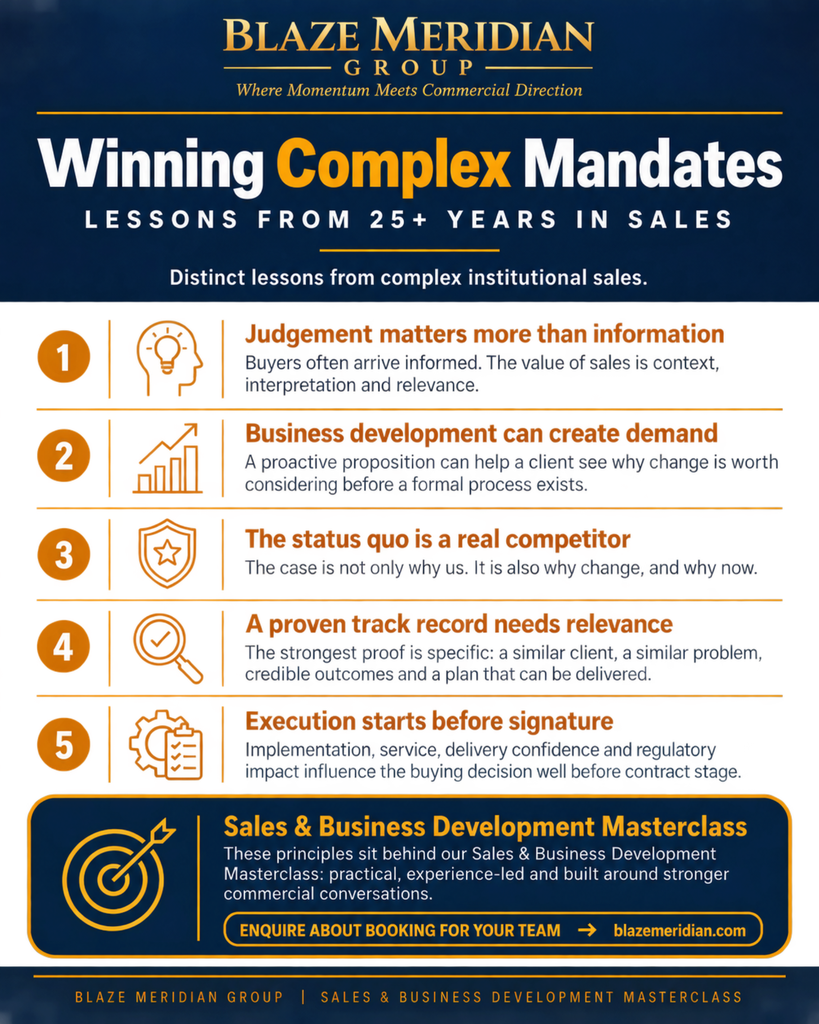
It is also part of why we decided to build a Sales and Business Development Masterclass at Blaze Meridian.
We see companies with strong products and capable teams where the commercial opportunity is greater than the sales process supporting it. The issue may be targeting, account planning, buying-group coverage, progressing opportunities, evidencing value or sustaining business development beyond the immediate pipeline.
We built the programme around disciplines I have used and coached in practice, drawing on live mandates and real sales situations rather than theory in isolation.
The methodology provides the structure. Experience and judgement determine how you apply it.